Chapters
Don't HR Alone · Episode 75
When Can Employers Legally Deny an ADA Accommodation?
Chapters (11)
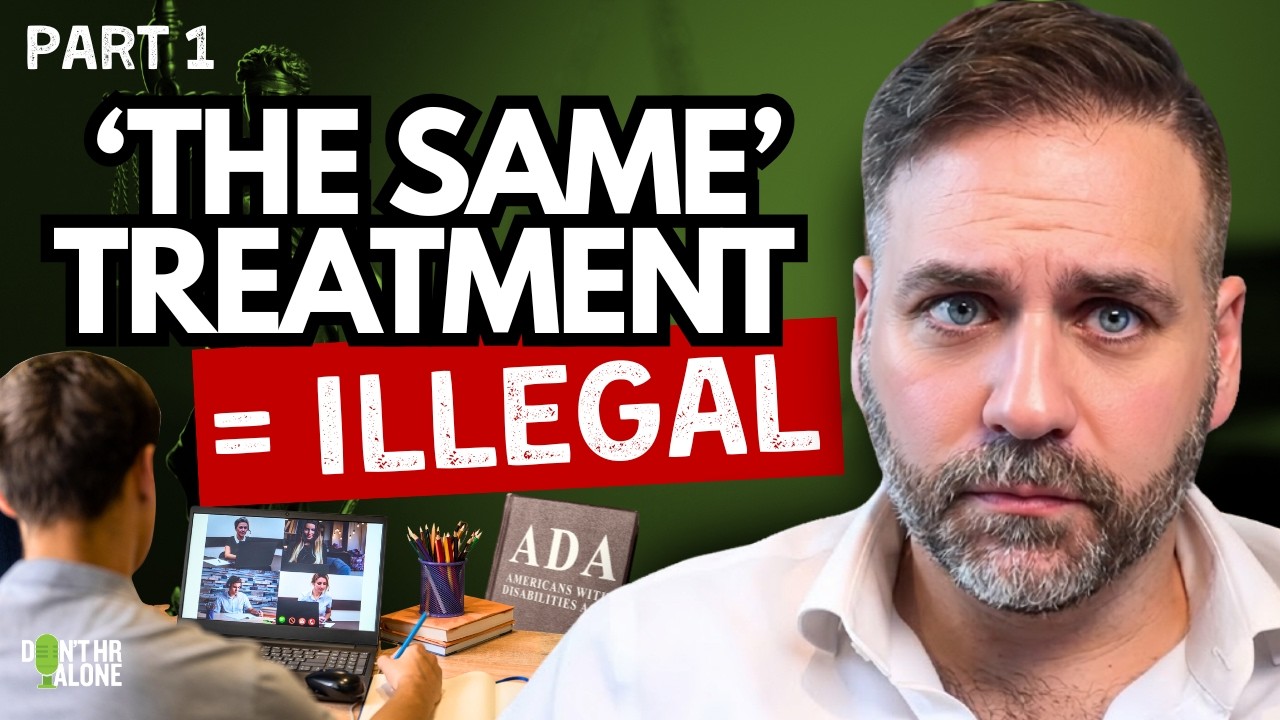
Many employers worry that the Americans with Disabilities Act (ADA) means saying yes to every request. In this episode, Part 2 of a series on accommodation, Rhamy explains the limits: situations where an employer does not have to grant an accommodation, even after engaging in good faith.
Part 1 covered the interactive process and the first three limits: undue hardship, eliminating an essential function, and demanding a preferred accommodation when another effective one exists. This episode covers the rest. Indefinite leave is never a reasonable accommodation; Rhamy points to Severson v. Heartland Woodcraft, where the Seventh Circuit upheld a termination after an employee who had used 12 weeks of FMLA leave asked for two to three more months. A direct threat, assessed individually and with evidence rather than stereotypes, can also justify a denial. The ADA protects only qualified individuals who can perform essential functions with or without accommodation. Employers never have to lower performance standards or excuse misconduct, and they can request reasonable medical documentation when a disability or need is not obvious.
Rhamy stresses that the ADA is proportional: undue hardship is measured against a business's actual resources, and most accommodations are cheap or free. Expensive claims rarely come from the accommodation itself; they come from refusing to have the conversation.
The episode closes with how to stay safe: individualize each accommodation decision, apply conduct and performance standards uniformly to everyone, and document every conversation, option, decision and reason.
Key takeaways
- When an employee needs medical leave, ask how long and set a definite return date, extending in defined steps rather than holding a job open indefinitely.
- Base any direct threat decision on an individualized, evidence-based assessment, usually with a doctor's input, never on stereotypes about a condition.
- Hold employees with disabilities to the same production, quality and conduct standards, and apply discipline the same way you would for anyone else.
- After disciplining disability-related misconduct, enter the interactive process to look for an accommodation that prevents it going forward.
- When a disability or need is not obvious, request documentation of its nature, severity and duration, but never the full medical file.
- Use the Job Accommodation Network, a free resource, to find low-cost accommodation options.
Is indefinite leave a reasonable accommodation under the ADA?
No. Leave is a common accommodation, but indefinite or open-ended leave, paid or unpaid, is not. In this episode, Rhamy points to Severson v. Heartland Woodcraft, a Seventh Circuit case. After the employee used 12 weeks of FMLA leave, he asked for another two to three months. The court upheld his termination, finding that a multi-month leave of absence is beyond the scope of a reasonable accommodation, and stating that "the ADA is an anti-discrimination statute, not a medical leave entitlement."
The principle is that without a reliable return date, an employer cannot plan coverage or decide whether to hire a replacement. A definite, time-limited extension that lets the employee return to essential duties can be reasonable if it is not an undue hardship. "I don't know when I'll be back" is not.
Rhamy's approach for a small business is to ask how long, grant leave in defined steps, require updates, and explain what happens if the employee cannot return by the agreed date.
What is a direct threat under the ADA?
A direct threat is a significant risk of substantial harm to the employee or others that cannot be reduced by a reasonable accommodation. If one exists, you do not have to keep or accommodate the employee in that role. Rhamy calls it a narrow escape hatch, not a catch-all.
It requires an individualized, evidence-based assessment, usually with a doctor's input, of four factors: the duration of the risk, the nature and severity of the potential harm, the probability it will occur, and how imminent it is. You cannot invoke direct threat based on stereotypes, such as assuming people with a mental illness are dangerous. A speculative or remote risk does not qualify; it must be real and documented.
Rhamy gives examples where it can apply: a machine operator whose condition causes sudden loss of consciousness around dangerous equipment, or a daycare worker responsible for infants whose doctor cannot say how to reduce the risk of seizures to a safe level.
Do I have to accommodate an employee who can no longer do the essential functions of their job?
Not if no reasonable accommodation would let them perform those functions. The ADA protects only a qualified individual, meaning someone who can perform the essential functions of the job with or without a reasonable accommodation.
Rhamy's example is a delivery driver who loses the ability to drive. No accommodation restores that ability, and if there is no vacant non-driving role the person is qualified for, the employer's obligation is over. You do not have to create a new job, bump another employee or promote the person.
He notes that licensing standards can make the answer clear. Commercial driver's licenses, nursing licenses and similar credentials carry their own requirements, and if an employee can no longer meet them, they are no longer qualified for the position. This is why clearly identifying the essential functions of each role matters before any accommodation question comes up.
Can I discipline an employee for misconduct caused by a disability?
Yes, as long as you would discipline anyone else for the same conduct. In this episode, Rhamy explains that the ADA does not require you to lower your standards or excuse misconduct. You never have to tolerate violence, threats, theft or destruction of property, even if it is disability related.
The key is uniformity. If an employee with a mental health condition yells at a coworker, you can impose the same discipline you would impose on anyone. If that conduct would normally earn a written warning, give a written warning; if it would get anyone fired at your company, the same applies.
Accommodation is prospective, not retroactive. After the discipline, you enter the interactive process to see whether something can help the employee meet the standard going forward. Rhamy also stresses consistent documentation of all adverse actions, not just for this employee, because disciplining a disabled employee for conduct you tolerate in others is discrimination.
Can I ask for medical documentation for an ADA accommodation request?
Yes, when the disability or the need for accommodation is not obvious. Rhamy explains that you are entitled to confirm two things: that there is an ADA disability, and that it makes the accommodation necessary. You can ask for documentation of the nature, severity and duration of the condition.
There are limits. You cannot demand the complete medical file or unrelated records. If the documentation is insufficient, explain why and give the employee a chance to provide more. You are not stuck taking a bare assertion at face value.
If both the disability and the need are obvious, you should not ask for documentation you do not need. Rhamy's contrast is between an employee who has lost a foot, where the situation speaks for itself, and an employee who says they sometimes have seizures and works with small children, where a doctor's assessment of severity and likelihood is reasonable before deciding what is safe.
How do small businesses avoid ADA accommodation lawsuits?
Have the conversation, apply standards uniformly and document everything. In this episode, Rhamy explains that the ADA is proportional by design: undue hardship is measured against a business's actual resources, so a small business reaches significant difficulty or expense faster than a large one. What is reasonable is, by definition, not an undue hardship.
Most accommodations are cheap or free, such as a schedule adjustment, working from home two days a week, a quieter workspace or a modified break schedule. The Job Accommodation Network (JAN) is a free resource for ideas.
Rhamy says expensive claims rarely come from the accommodation itself. They come from employers who refuse to engage, saying "we treat everyone the same." He cites an average ADA settlement of $125,000, compared with a couple of hours for a documented interactive process. His three rules: individualize each accommodation, stay uniform on conduct and performance standards, and document every conversation, option, decision and reason.
About this episode
The Americans with Disabilities Act (ADA) requires reasonable accommodations, not unlimited ones. While employers are legally mandated to engage in a good faith interactive process, federal law provides 8 distinct boundaries where you can legally say NO.
In this episode of Don't HR Alone, Rhamy Alejeal breaks down the legal protections built into the statute to safeguard your business. Learn how to evaluate requests, protect your core operations, and handle accommodation limits without risking $125,000+ in EEOC liability.
You'll Learn: 📌 Undue Hardship: How business size and resource limits dictate financial/operational hardship. 📌 Essential Functions: Why you never have to remove core job duties for an accommodation. 📌 Preferred vs. Effective: Why employers get the final say on which accommodation is implemented. 📌 Indefinite Leave: Why open-ended time off is never considered a reasonable accommodation. 📌 Direct Threat: The 4-factor medical assessment required to prove significant safety risks. 📌 Performance & Conduct: Why the ADA never requires you to lower quality bars or excuse past misconduct. 📌 Reasonable Documentation: When you can demand medical proof and when you must skip it.
This episode is for educational purposes only and does not constitute legal advice.